Saturday, July 2, 2022

Portugal Loves Their Festivals


We have been exploring our neighborhood and nearby towns this month.  June is a month of holidays in Portugal including Portugal Day, Corpus Cristo and the festivities for the Popular Saints.

typical narrow street with seating in the for dinner

Portugal Day on June 10th marks the date of Luís Vaz de Camões' death on June 10, 1580 and is Portugal's National Day. Camões ("kam-mo-ish")  wrote the Lusiadas, Portugal's national epic celebrating Portuguese history and achievements. In Olhão there were two large outdoor concerts, one was a rock group that drew about 5,000 people.  We didn't go but could hear the music and applause from 1/2 mile away!

Festas dos Santos Populares (Popular Saints' Festivals) are held in June in large cities and small towns throughout Portugal. They are dedicated to Saint Anthony (Santo António), mainly in Lisbon, and Saint John (São João) and Saint Peter (São Pedro).

One of the interesting traditions is the giving of a little plant to your friend, somewhat like a valentine plant.  

the little basil plant

The Manjerico is a popular plant of St. Anthony parties (the Saint celebrated in Olhão). According to the manjericos tradition, during the celebrations of the Saints in June, the boyfriend (or friend) offers to his girlfriend one little potted Manjerico plant. In addition to the plant, the container has a paper-mache flower and a small flag with a popular verse allusive to love.  One evening there was a knock on our door and Manuela, our neighbor, brought one to us and told us the name of the plant but I had to look up the story as I couldn't understand that much Portuguese-LOL.

Years ago the Popular Saints Day was a huge festive in Olhão.  The narrow streets were decorated with colorful banners, intertwined paper chains and colored lamps.  Homes opened their windows and brought flower pots outside.  Parades with dancers in colorful dressses and religious icons paraded down the streets.  This large practice has wained but streets still proudly display ceramic tiles recognizing those that were sites of these parades. 

This is our street

One day we took the train to Tavira, about 15 minutes away, to enjoy their huge weekend festival  

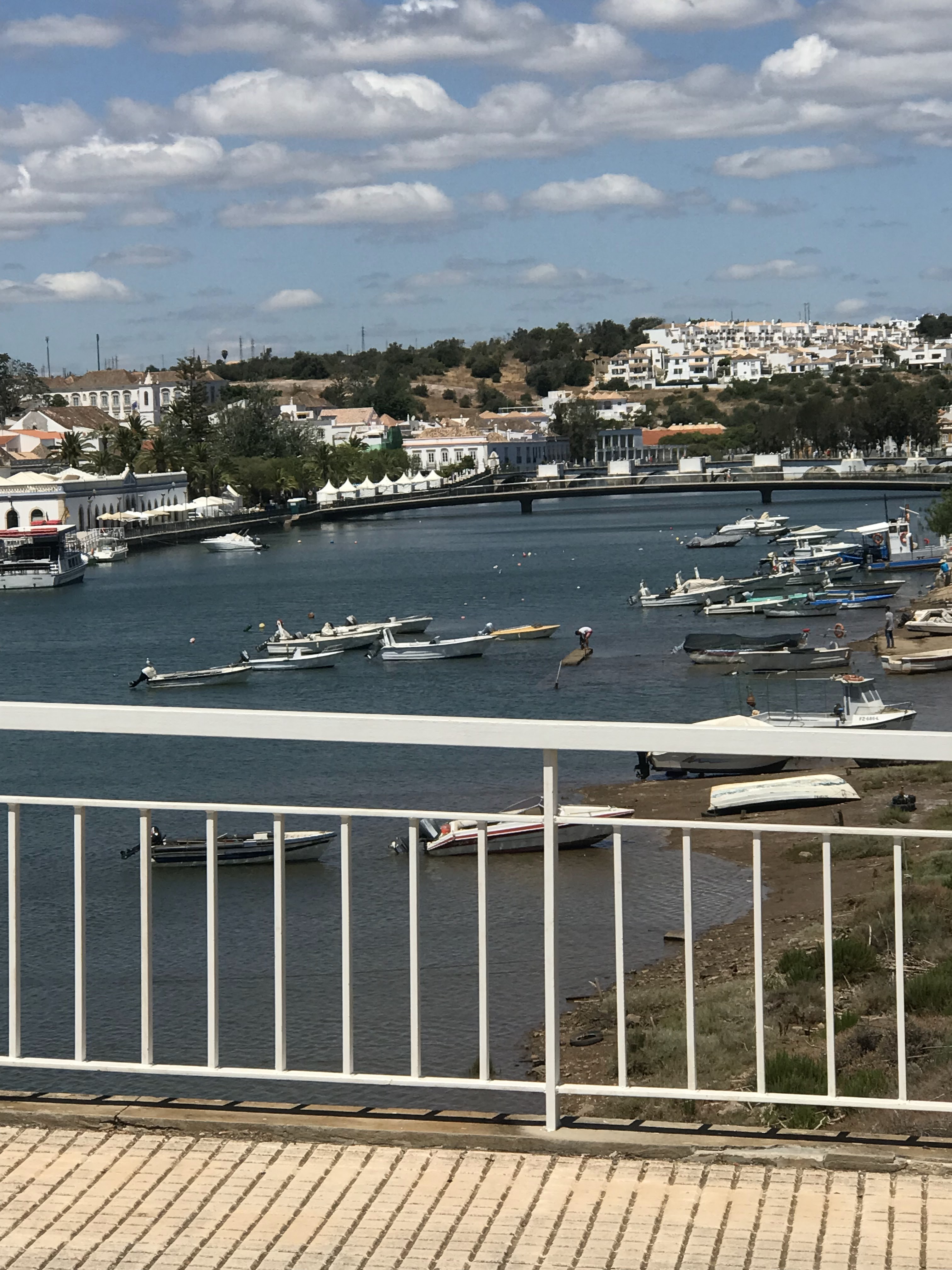
Looking into Tavira and the Gilão River

We stated overnight in a small hotel, Marés,  right on the river and in the middle of the revelers. The hotel wasn't that old but they commissioned local artists to use old ceramic tiles and wood.  It was very lovely.

street displayed photos of over 20 churches in Tavira

the plaza was decorated with festives banners & flags

Besides the street decorations, the cobbled street was carpeted with fresh mint branches that when stepped on by the crowds emited lovely smells.  

I don't know if all festivals are the same, but Tavira and Olhão used these musical events as fundraisers for community organizations and youth groups.  The highlight of the evenings are the grilled sardines sold at each booth! 

the sardines on the grill- imperfect fish are just tossed over the railing!

In Tavira each vendor grilled the sardines and offered them for "free"....you pay for the bread and the sardines come free!

one sardine with bread ($1.56) or 5 sardines with bread (about $6.25)
 
Huge crowds of local families and lots of expats mulled around visiting, eating, drinking (the €1 beer) and dancing to the live music.  We lasted until about 11:30 pm and headed back to our room to listen to the amazingly loud fireworks.

the River Gilão 

Portugal has many public holidays and "Bank Holidays" (just a term for a 3- or 4-day weekend).  On a long weekend in June we participated in a Geocaching Rally here in Olhao.  There were about 230 people signed in for the weekend but we were the only "native English speakers".  Initially we thought we would just be hanging around the fringes, but soon we began meeting Portuguese geocachers who spoke some English.  This was really interesting and fun to be immersed with the locals.

"Return to the Sun" or Welcome Spring!

The Dinner was a feast of the Algarve-this is a giant Cataplana pot that is used for cooking a full meal of fish, shellfish, chorizo and vegies.  Lots of wine, cheeses, olives, bread & typical baked desserts...all for €18 (about $18.77).  

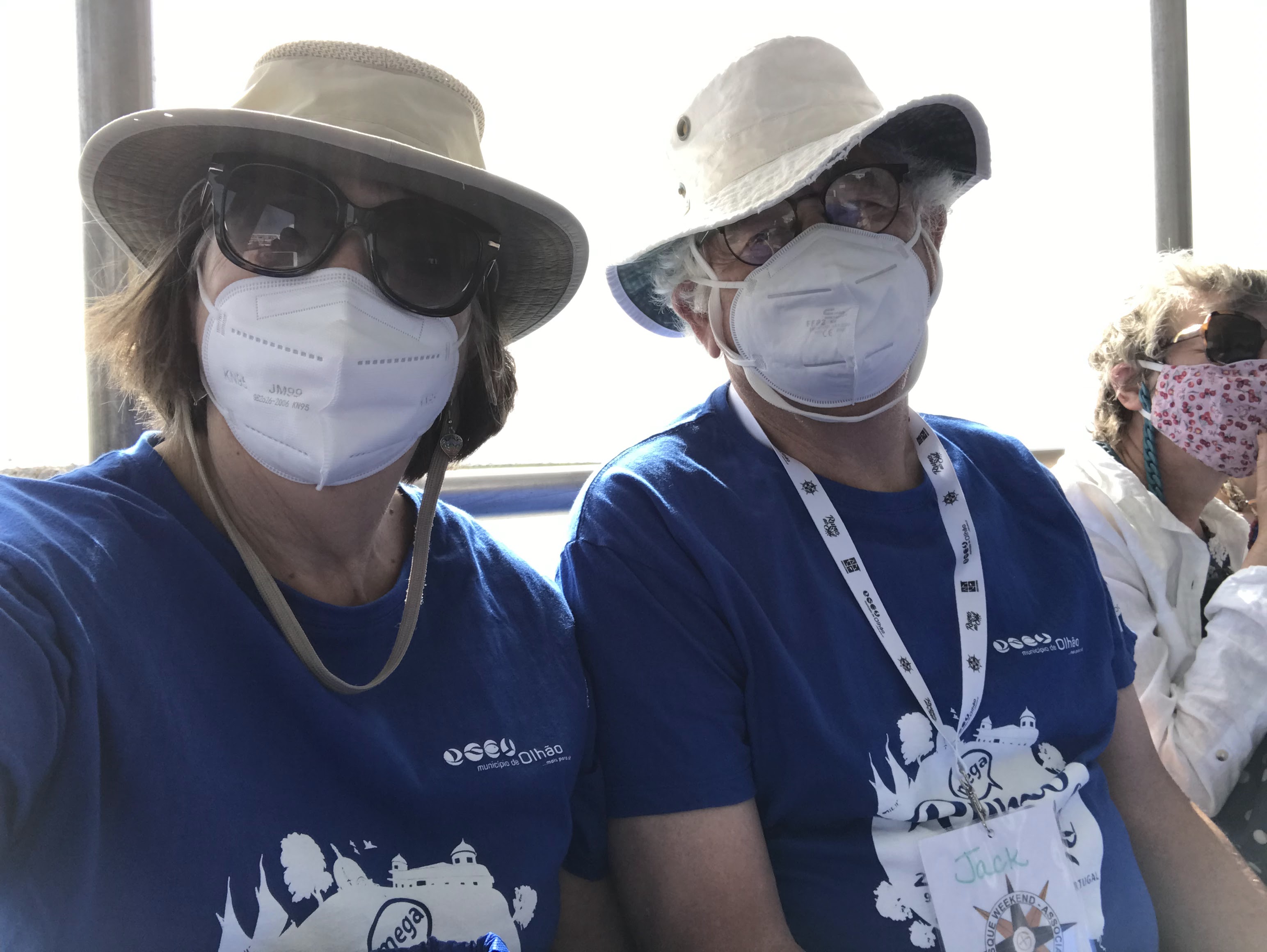
required masks on public transportation (and some stores)-we were on the ferry 

CITO ("Cache In-Trash Out") event on Armona Island. Most of the trash was just left in these old boats that on left on the sand (they are used but this must be free "docking")

I've mentioned Manuela several times in my blog posts.  She lives nextdoor to us and is our landlady who has become a friend.  Her language is Portuguese and ours is English and our common language is "translation online".  Manuela invited us for the day to her family holiday home on Farol Island, one of three barrier islands on the sea that are accessed by ferry. 

She has owned this home for 40 years - simple and perfect for family use

We spent the whole afternoon together talking in my very limited Portuguese, hand signs and translation.  Another fun day getting to live with the locals.

 Manuela using her phone to translate to me-it's slow and often funny but works


She also treated us to a wonder sardine dinner at her favorite restaurant on the island-way more food than we could even eat!


Monday, June 6, 2022

Checking Out the Medical Care


 Firstly, Portugal provides health care for all people (free for children and over 65) through the Centro de Saude, but The Portugal News states that about 1 million people don't have a family doctor assigned to them.  As a result this can mean very long wait times for appointments and long cues, sometimes up to 4 hours even with an appointment. The physician I saw said he had worked for the public health system and his "take-home after taxes" salary was about $1,300/month - and that was after 13 years as a doctor!  Needless to say, doctors and nurses are leaving the public health system for either the private sector or emigrating to other EU countries.  

As residents, we qualify for the state health service at the Centro de Saude (Health Center) however since we have never paid into the national system and we can afford to purchase insurance we decided for this option.  The price of our private health insurance is about $106 per month for both of us.  This includes both hospital inpatient, primary care, specialists and out-patient services. 

I was unsuccessful in trying to use the medical insurance website as it is only in Portuguese and requires transtlating each page or trying to reach an English speaker on the helpline (ring-ring-ring....)!  I reached out to our facebook "Ex-Pat" group and discovered a better source to find a physician.  The fairly new (2009) Hospital Particular do Algarve/Gambelas in Faro is our closest hospital and accepts our health insurance (not all do).  Their website is much better, in English and allowed me to make an appointment quickly.  I just selected the specialty I needed (orthopedics) and I could see a list of doctors.  I filled in a form and received an email back in two days with an appointment scheduled for two weeks. I have repeated this process for my annual oncology consultation and mammogram which went just as smoothly.  

So the day arrives and getting to the hospital without a car requires a 10 minute train ride from Olhão to Faro (75¢) and then either a taxi (about 15 minutes and cost about $12.00) or a 30 minute bus ride (cost $2.40).  We took the taxi the first time then after that we figured out the bus route.  I had to return the next day and did the whole trip-train/bus by myself.  Everything fell into place and I even had a few minutes before the return train to shop and grab a snack.  The whole process takes a bit longer than if we had a car, but hey! we're retired.

Just some observations on the hospital & care: Everyone is greeted at the entrance, takes a number and waits to check in at a central window where registration is completed.  Then we went down a hallway to the outpatient consultation area and sat in a row of chairs along the wall.  After a few minutes the doctor came out to call me into the room where I sat at his desk and showed him the reports from the physicians in Idaho & Oregon.  No nurse, no BP or temp, no "history" taken.  The doctor typed into the computor a referral for two x-rays and directed me downstairs to imaging.  Again, check-in at the counter and wait 15-20 minutes.  The x-ray tech had a small, but efficent room and took two x-rays.  Back upstairs to the doctor, wait in the hallway for another 10 minutes and then called in.  After showing me the x-rays on the computer, he typed in a referral/prescription for physical therapy and gave me a name & the general location in Olhão (because I didn't want to come back to the hospital 3 times a week!).  Back to the registration desk, take a number to wait my turn and then pay my co-pay of $17.00 plus $5.25 for the x-rays.  All in all, it took about 1-1/2 hours.  The doctor seems absolutely "competent" and the same as any doctor I have visited in the U.S. The only difference was the cost-effective measures of not requiring superfluous  exams, questions, or irrelevant detailed medical history .


Back in Olhão I searched on my Portuguese insurance website to find a physical therapist who accepted Medís insurance.  There were two and reading the patient reviews directed me to Clìnica de São Miguel.


 I called and spoke to the receptionist, in English, and made an appointment for two days later.  An easy 10 minute walk to the clinic and absolutely no wait!  The physical therapist, Adriano, did not speak any English so we did a lot of motioning and pointing and a little Google translation.  

He utilized the procedures prescribed by the orthopedist-therapeutic ultrasound, TENS unit with heat, manipulation and stretching.  

Basic room -TENS unit with 20 minutes of heat

I paid $5.35 per session.  After five days I was so much improved that I decided to stop.  Overall a very successful treatment!

Whew! Well, our inital experience with Portuguese health care was positive, professional and reletively inexpensive. 

In between these appointments we did get in a little sightseeing to Óbidos (a walled historic village) 

and Nazaré (100 ft. gigantic surfing waves) on the train 

Winter waves are world famous 

and bus to visit some folks who were vacationing from Coeur d'Alene, Idaho.


Jack & Karen with Carol & David 


Friday, May 20, 2022

The Wild Coast of Donegal


On to Dublin, Ireland from Barcelona, Spain for our next adventure....again change of plans!  We had an old country home lined up to stay in for 10 days but it didn't work out.  The house was too rural and in need of care after being essentually unused during Covid lockdown.   So off we go with "PLAN B"....or was it C, D, or E?


On our last visit to Ireland in 2017 we spent 3 weeks exploring the Wild Atlantic Way, a winding connection of 2500 km (1,600 miles) of roads along the Irish west coast. We had complered 4 of the 14 stages of the route and decided to finish it.  Starting in Sligo, while we didn't drive every single little two- and one-land road, we did experience some spectacular coastal cliffs, hills covered with varieties of sheep with lambs, bogs and ancient castle ruins.  

Donegal Castle
Original home-turned-castle was the base for the mighty O'Donnell clan in 1500.  It was expanded by the English when they defeated the Irish in the Nine-Year War (1594-1603)
  

Amazingly this is the original stone floor!

We drove on along the coast in County Donegal and were enthralled about the story of Father McDyer's Folk Village in Glencolmcile.  Father McDyer came to the area in the 1950's to the impoverished community that had suffered 60% loss of population due to emmigration.  He vowed to stem that trend and spent 35 years bringing electricity, industry, education, jobs and tourism to improve the people's lives.  The Folk Village was built in 1965 to bring in tourists and share the historical culture.  

this stone home demonstrated the farmimg and fishing life in the 1500's 

the peat chimneys were just carved into the wall & open to cook and heat but created a lot of smoke inside


old rope thatched roof with straw


here's a short video about County Donegal craftmen thatching a cottage/pub  They are beautiful works of art that are still around in smaller villages.  Enjoy the accents!

Hedge schools" (Irish: scoil chois claí) were small informal secret and illegal schools, particularly in 18th- and 19th-century Ireland, designed to secretly provide the rudiments of primary education in Irish to children of 'non-conforming' faiths (Catholic and Presbyterian) during British occupation.  Those caught teaching could be arrested and executed.
little spots carved into hedges


In Killybegs we took a 3 hour walking tour offered by the Tourism Center and it turned out just to be us.  It was supposed to be less than 2 hrs but I was still walking slowly.  Many Irish towns & cities have nonsensical names which were anglicized from the Gaelic.  Killybegs comes from the Gaelic "Na Cealla Beaga" that translates to "small cells"-referring to the early settlement of monks in the area who lived in little stone "cell" dwellings.
Sometimes the monks "hid" in these cells to write and translate religious writings.  They would use a rope to climb into the window then pull it up to protect the inhabitants..


Killybegs is the largest fishing and processing port on the island.  However the industry is reducing drastically and these million dollar boats go out only a few months a year.  Like many production communities, the locals can't buy fresh fish caugh by their fishing boats.


ruins of the church of St Catherine (of Egypt) started in the 1400s 

The historical timeline of Killybegs even includes the Spanish Armada when the ship La Girona, a galleass merchant ship developed for military purpose, docked in 1588 for repairs and they picked up survivors from other wrecked ships… but it overloaded the ship. 


see the castle ruins on the cliff

The most northern Antrim Coast is loaded with unique sites.  The rugged cliffsides and beaches provide many seaside resorts such as Portrush where we stayed.  This town looks very much like an old-fashioned seashore resort like we see in British television and has been filled with holiday makers since the 1800's. 

the kitschy rides at Portrush 


Dunlace Castle


Dunlace Castle, perched on the cliff edge, was built in the Middle Ages in several stages and housed several Irish Chieftain families.  Remember the La Girona, the Spanish Armada ship?  It wrecked against the rocks here just after leaving Killybegs in October 1588 and 1300 sailors perished leaving only 9 survivors.  Wreckage from the ship was used in the castle.  Dunlace was lived in until mid 1600's until the stormy weather began chopping away stone walls and they fell into the sea below.  The REAL stories of the constant flighting, killing and vicicious chieftain lords certainly leant reality to the series "Game of Thrones" which was filmed in many sites around here, including this castle.  

A tour with tasting at the oldest licensed distillary in Ireland.


I had heard about the Giant's Causeway but couldn't imagine the unique geological rock formations.  The local myth tells of the mighty giant, Finn MacCool, who built the stone bridge to cross over to Scotland to fight his rival giant.  But there are also other plausible theories of origin put forth by Neptunists (rocks cryatallized under the ocean) and Volcanologists (basalt columns formed from lava and cracked as they cooled).  Not too many years ago scientists calculated the temperature that lava turns to rocks in volcanic  Iceland and related this to the causeway pillars- so I guess the volcanology won out over the giant.  
the "steps" and columns have 5 or 6 regular sides


most are regular hexagons

We stayed in a many unique bed 'n breakfasts, old Irish guest houses, small hotels and rooms in private homes.  Our last night was on a farm in the centuries old stone house that was the original farmhome.  We were treated to fresh chicken and duck eggs for our breakfast.


 This is the final post of this blog that was about our travels and adventures.  After returning from Africa, Jack became ill with pneumonia...